News
News
Carbon instead of palm oil
Mibelle, LanzaTech and Fraunhofer develop alternative for cosmetics
The Swiss Mibelle Group, the American carbon cycle specialist LanzaTech and the Fraunhofer Institute for Interfacial Engineering and Biotechnology IGB have developed a palm oil-free fat from carbon dioxide in a long-term research project. The biotech process makes it possible to sustainably replace palm oil in cosmetics and other everyday products, the companies report in a joint statement. Until now, palm oil has been used in many food and cleaning products, cosmetics and biofuels due to the high yield of the oil palm, its long shelf life and its heat resistance. However, large areas of rainforest are being cleared for cultivation. This threatens animal and plant species and releases large amounts of the greenhouse gas CO₂.
Fermentation to produce a fat mixture
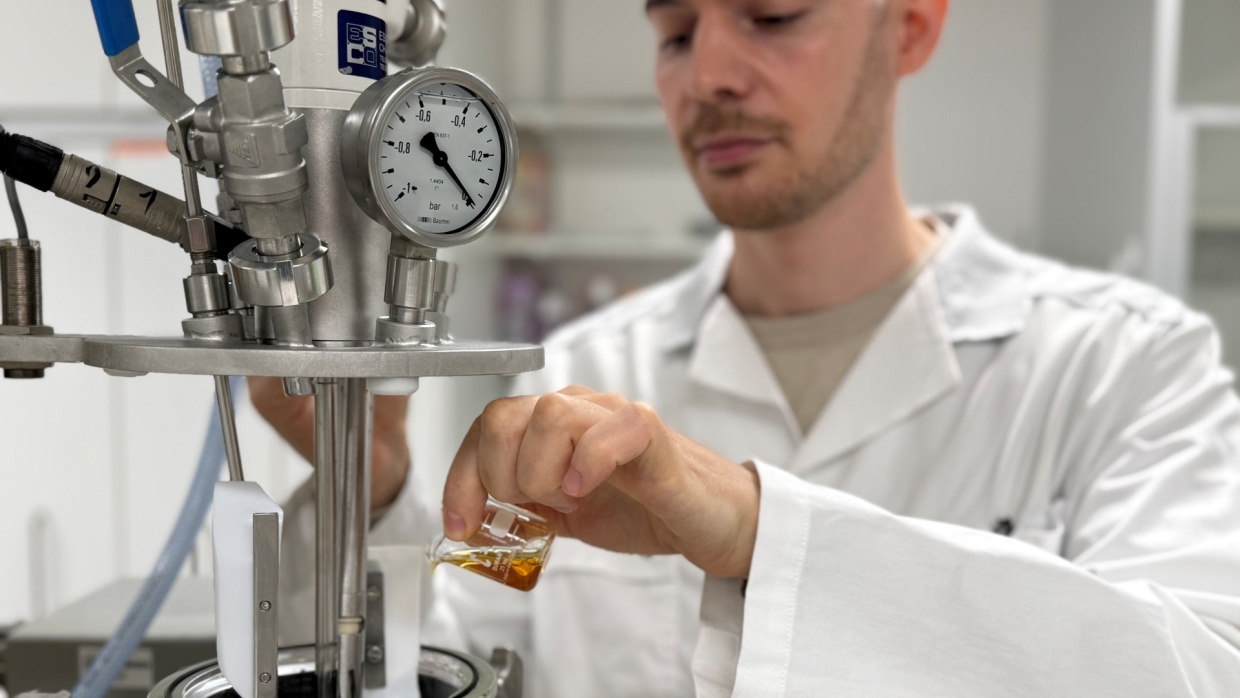
The Swiss Mibelle Group, together with LanzaTech and the Fraunhofer Institute IGB in Stuttgart, has now converted CO₂into a palm oil-free fat mixture by combining two fermentation processes. The companies emphasise that it is so similar to palm oil that it can replace tropical oils in many applications. In the first step, the gas that would have been emitted as CO₂ is converted into alcohol using a gas fermentation process developed by LanzaTech. In the second fermentation process, which was largely developed by Fraunhofer IGB, the alcohol is converted into fats using specialised oil yeasts. Only naturally occurring microorganisms are used in this process. The end product is a natural, versatile, high-quality fat with excellent nourishing properties for cosmetic products.
Large-scale production has begun
Following laboratory trials at Fraunhofer IGB and application tests at the Mibelle Group, the partners have begun manufacturing the palm oil-like fat mixture in a pilot plant in Leuna. To this end, the fermentation processes at the Fraunhofer Centre for Chemical-Biotechnological Processes CBP are being gradually transferred to a larger scale. "This is the important next step, at the end of which we will have the first quantities of a high-quality fat," says Susanne Heldmaier, Head of Research & Technical Innovation at the Mibelle Group. The process makes it possible to develop cosmetic products that protect the skin and the environment. "In the future, we hope to be able to convert more and more palm oil-based raw materials to this sustainable solution with the support of our raw material suppliers," says Heldmaier.
Source: Fraunhofer IGB